




“Someone is sitting in the shade today because someone planted a tree long ago.”
This quote from Warren Buffett on investment portfolios could describe the evolution of patient engagement over the past decade. Much like a carefully built portfolio, the dividends from years of investments in health IT continue to emerge. It is useful to take stock of the dividends of our digitization efforts.
In our first post in the Digital Dividends blog series, we explored how more individuals than ever are accessing and using their health information online, especially those managing chronic conditions or a recent cancer diagnosis. In this post, we look at how U.S. hospitals are helping enable that access, with a focus on where policy priorities, patient demand, and industry efforts have aligned to deliver on the promise of digitalization.
The Eras of Patient Engagement
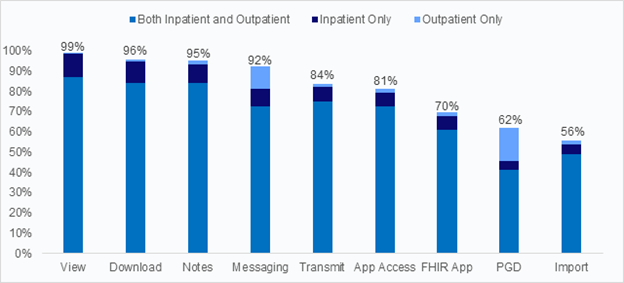
Our recent data brief shows widespread adoption of patient engagement capabilities among hospitals. Patients can now view, download, and transmit their health data; import records from other organizations into a patient portal; view clinical notes; access information via apps; submit patient-generated data; and securely message providers.
Figure 1. Non-federal acute care hospitals’ adoption of nine patient engagement capabilities, 2024
Source: 2024 American Hospital Association Information Technology Supplement.
Notes: PGD= patient-generated data. For more details, please see the data brief.
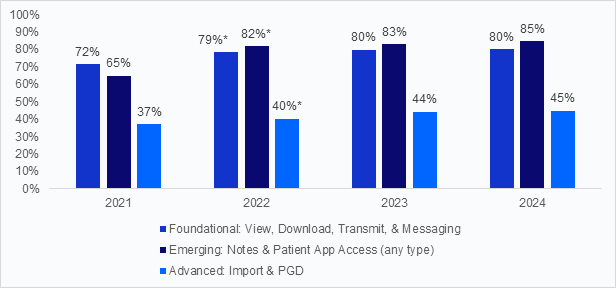
After more than a decade of policy making and private-sector innovation, patient engagement has unfolded in three eras coinciding with evolving phases of policy: foundational, emerging, and advanced. These eras are not defined by adoption rates alone but by policies and innovations that set the stage for hospitals to invest in patient engagement capabilities.
The Foundational Era of patient engagement was spurred by the HITECH Act and the Promoting Interoperability Programs (formerly Meaningful Use), which incentivized hospitals to adopt and demonstrate meaningful use of certified electronic health record technology. Foundational patient engagement capabilities – such as viewing medical records and messaging providers –were supported. In 2012, prior to the PI program, only 24% of hospitals provided patients with the capability to electronically view their health information. In 2025, 80% of hospitals reported adoption of all four foundational capabilities (view, download, transmit, and message), with nearly all hospitals (99%) enabling patients to view their health information electronically.
The Emerging Era of patient engagement focused on expanding transparency and choice. This was driven by the 21st Century Cures Act and reinforced by subsequent Information Blocking regulations, which focus on reducing impediments to the access, exchange, or use of electronic health information. This era spurred hospitals’ adoption of capabilities to enable patients to have electronic access to their clinical notes and access their health information electronically via smartphone health apps. Now, more than 4 in 5 hospitals report supporting patient access to their information via apps, with 70% enabling HL7® Fast Healthcare Interoperability Resources® (FHIR®) based app access.
We are now in our Advanced Era of patient engagement where hospitals are increasingly allowing patients to import and upload their own data, a key advancement in patient-centered care. Currently, less than half of hospitals enable this capability, which had not previously been driven by federal policy or incentives. Nevertheless, we note that there has been an upward trend in growth showing hospitals’ readiness to support more connected patient access and engagement. The Trump Administration earlier this summer announced progress toward building a smarter, more secure, and more personalized healthcare experience in partnership with innovative private sector companies. Through its most recent Health Tech Ecosystem announcements, CMS also issued a call to action urging exchange networks, payers, providers, and developers to move toward the “advanced era” of patient engagement.
Figure 2. Non-Federal Acute Care Hospitals’ Adoption of Foundational, Emerging, and Advanced Engagement Capabilities in Any Setting: 2021-2024
Source: 2021-2024 American Hospital Association Information Technology Supplement.
Notes: “Foundational” refers to hospitals with early core patient engagement capabilities (view, download, transmit, secure messaging); “Emerging” includes those that added newer Cures Act–related capabilities (clinical notes and patient app access); and “Advanced” covers capabilities not yet required or incentivized (data import and patient-generated data [PGD]). *Indicates statistically significant difference from the same group in the preceding year at the 5% level. For more details, see the data brief.
The New Digital Health Norm
Since the onset of the COVID-19 pandemic, patients have come to expect a “new normal” regarding engagement with their health information. Demand for electronic access has surged, with patients now expecting near-instant access through smartphone apps. Our recent brief shows that federal policies and incentives aimed at enhancing patient access and hospitals’ achievements in offering these capabilities to patients have contributed to greater access and innovation.
Variable Returns and Looking Ahead
Community hospitals are the primary source of care for many Americans, and hospitals have been crucial enablers of electronic health information access. However, these gains have not been uniform. The foundational capabilities are nearly universal across hospitals, but more advanced capabilities like importing records and patient-generated data still lag among lower-resourced hospitals. These variable returns reflect the differences in hospital resources and vendor capabilities and have downstream implications for the patient populations they serve.
Looking ahead, the federal government, working alongside the health IT community, provider groups, payers, patients, and other stakeholders, will continue the hard work of advancing patient empowerment. Policy support and technical progress will be essential to ensuring that all patients have access to the most impactful patient engagement capabilities. The health technology ecosystem recent request for information from CMS and ASTP/ONC underscores the need to expand access to technologies that empower patients to make informed decisions. Public responses offer us insights into where we have made progress and where more work is needed. Above all, patients want reliable, secure, and user-friendly systems that work for them. As we reflect on these responses, they’ll help us shape our policy priorities surrounding patient access to their health information.
As this blog series continues, we will examine additional dividends and where our investments in digital health continue to yield value.